Skip to content
Growth6 min read

Winter Emergency Calls Are Coming. Is Your Business Ready?

The first hard freeze brings a short, sharp spike in no heat and burst pipe calls. How to answer, route and advertise for that week before it arrives, so the work does not go to whoever picks up first.

By the Ethixweb team 6 min read

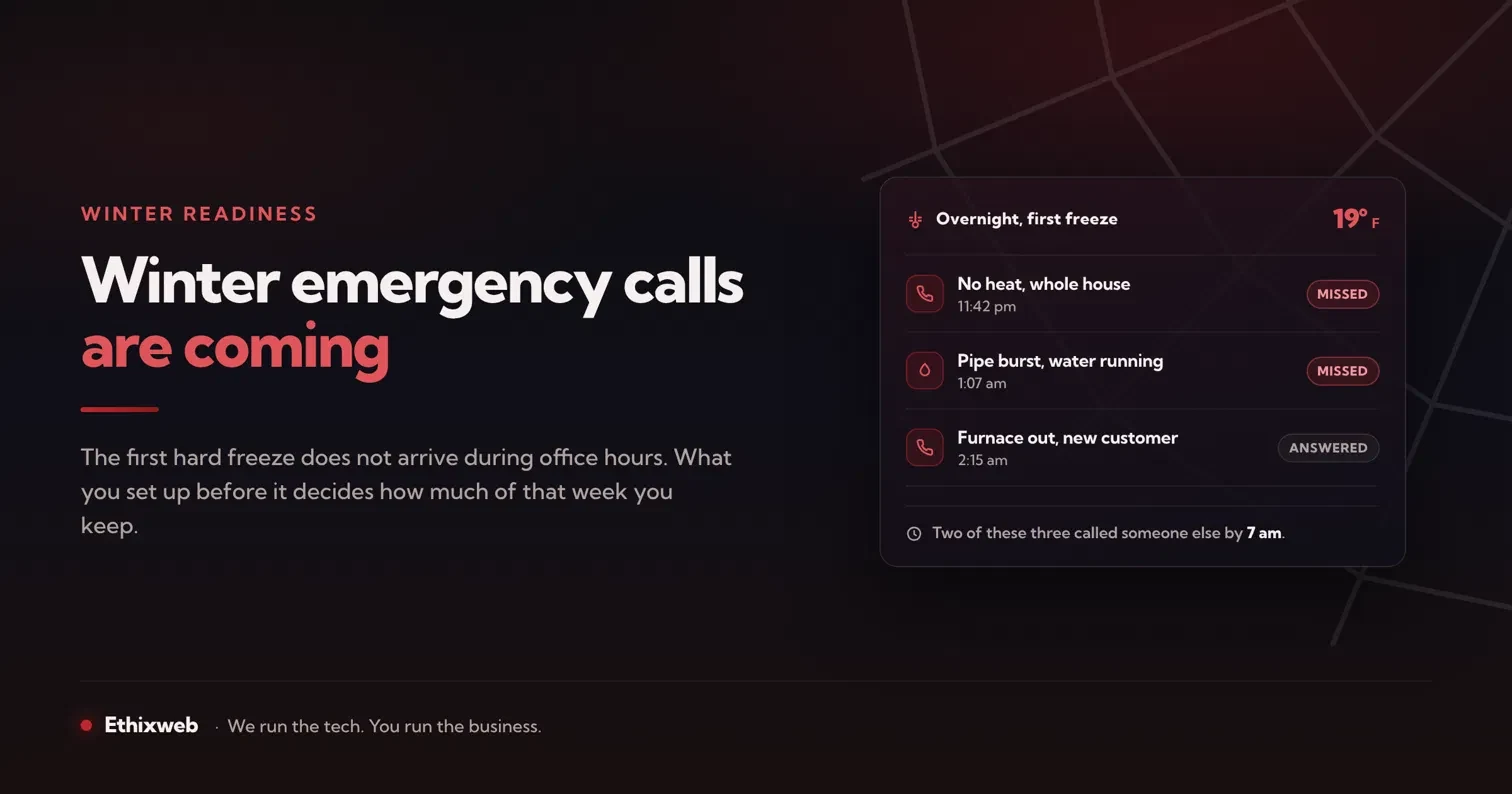
Overnight call log during the first hard freeze showing two missed emergency calls and one answered, with a note that two of the three callers hired someone else by 7am

Winter's first real freeze does not wait for a slow Tuesday. Furnaces that limped through November quit all at once, pipes in an exterior wall split overnight, and the phone starts ringing with the kind of emergency call that cannot wait until Monday.

HVAC and plumbing businesses that plan for that week capture most of the winter emergency rush. Businesses that react once the calls start usually watch a good share of it go to whoever answers first, whether that is a competitor down the road or a voicemail box the caller never checks again.

Why one cold snap can double your call volume overnight

A hard freeze does not raise call volume evenly. It spikes it. During the severe winter storm that hit Texas in February 2021, one Texas HVAC contractor told ACHR News that call volume "shot up over 200% from what is considered normal." Few areas will see anything that extreme, but the shape of the spike is the same everywhere a hard freeze hits: a short, sharp surge that overwhelms whatever capacity felt normal the week before.
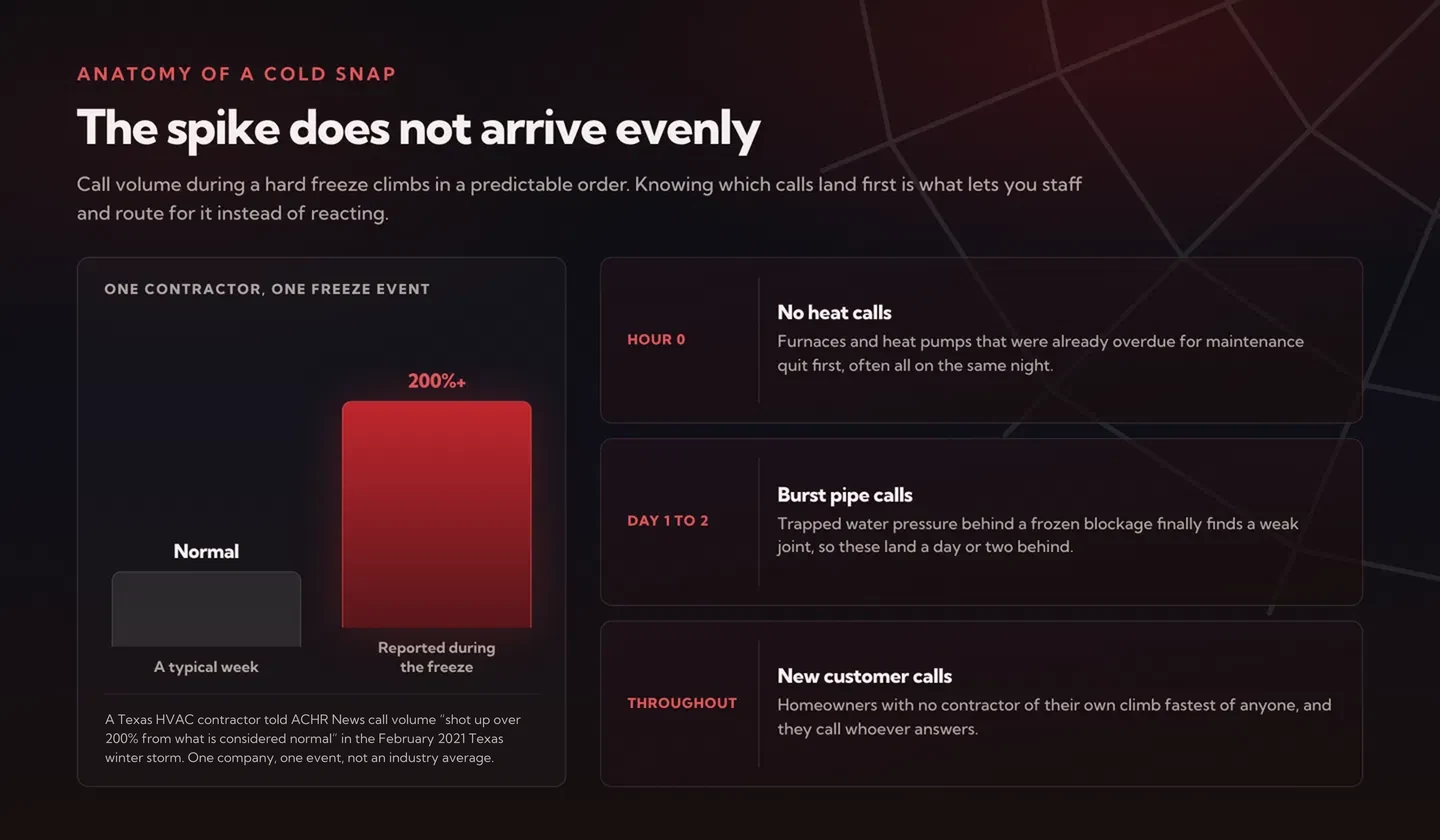
Chart comparing a typical week of call volume with a freeze week, next to the order calls arrive in: no heat first, burst pipes a day or two later, new customer calls climbing throughout
The spike does not arrive evenly. Knowing which calls land first is what lets you staff for it.

Pipes do not usually burst from the ice itself. According to the Insurance Institute for Business & Home Safety, once a pipe freezes solid between a closed faucet and the blockage, continued freezing builds pressure in that trapped section, and the pipe fails at its weakest point, often somewhere the ice has not even reached. That is part of why burst pipes are a leading cause of property damage from winter weather: the failure can show up anywhere in a home's plumbing, not just at the coldest spot.

A few patterns tend to repeat during that first hard freeze each year:

  • No heat calls arrive first, often from furnaces or heat pumps that were already overdue for maintenance.
  • Burst pipe calls follow a day or two behind, once trapped water pressure finally finds a weak joint.
  • New customer calls climb fastest of all, since homeowners with no existing contractor are the ones searching Google at 11pm.

A missed call during a freeze is rarely a delayed job. It's a lost one.

A homeowner with no heat on a freezing night does not leave a voicemail and wait. They call the next number on the page. Ethixweb's missed-call calculator shows what that costs: one example built from typical missed-call and close rates shows a contractor losing roughly $93,600 a year, or 208 first-time jobs, to calls that simply went unanswered. During a freeze week, that number does not shrink. It is usually the week it gets worse.

What answering the phone has to look like during the surge

A standard after-hours answering service that only takes a message does not solve a freeze week problem. The homeowner still waits until morning, and by morning they have usually called someone else. What works instead:

  • Route real emergencies immediately. No heat, no cooling during a heat wave, and active leaks go straight to the on-call technician, by call or text.
  • Book the routine work. Anything that is not an emergency gets scheduled directly into the field software already in use, whether that is ServiceTitan, Jobber or Housecall Pro.
  • Text the caller who hangs up. A homeowner who calls three contractors in five minutes and gets through to none of them rarely waits for a callback. A text sent the moment they hang up keeps that job in play.
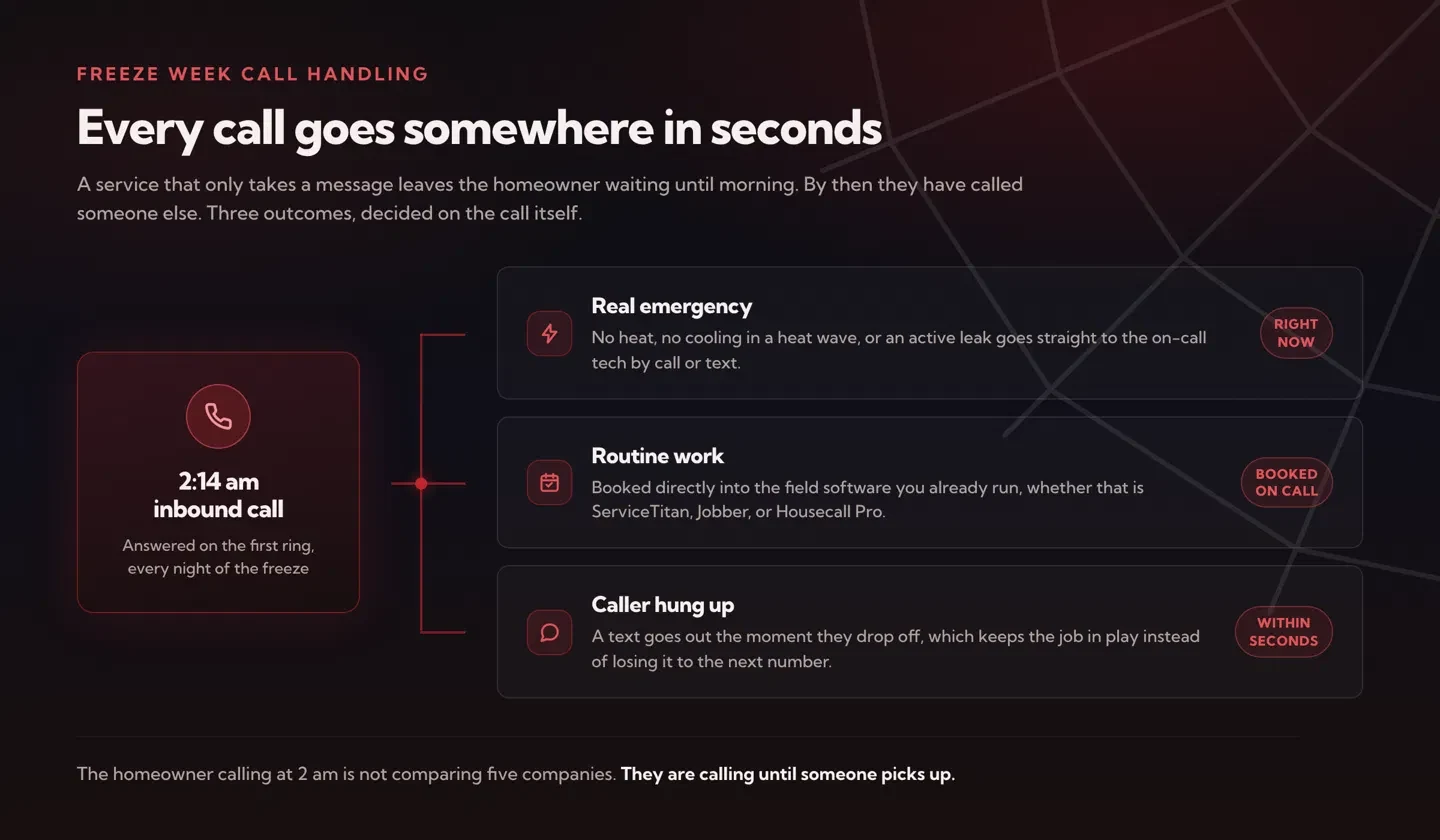
Call routing diagram showing a 2am inbound call splitting into three outcomes: real emergencies to the on-call technician, routine work booked into field software, and a text sent to callers who hang up
Every call goes somewhere in seconds, decided on the call itself.

Ethixweb's AI receptionist for contractors is built around exactly that pattern. The setup runs in four steps before a freeze ever hits: map current call volume and the kinds of requests that come in, set the rules for what counts as an emergency and who gets forwarded, connect it to the phone line and field software and test it with real calls, then review and tune it once it is live. Doing that work in October costs nothing when the week finally comes. Our guide to missed calls and the AI receptionist fix goes deeper.

Decide emergency ad spend before the forecast changes, not after

Most HVAC and plumbing companies set one marketing budget and leave it alone for months. A forecast freeze is one of the few moments worth breaking that rule. Raising Google Ads or Local Services Ads spend for emergency service keywords in the days before a hard freeze puts a business in front of homeowners exactly when they start searching, instead of a day behind every competitor who already raised their own budget.

This only works when the groundwork is already done. Ad copy, landing pages and the phone answering setup above all need to exist before the freeze shows up in the ten-day forecast, not get built while the calls are already coming in.
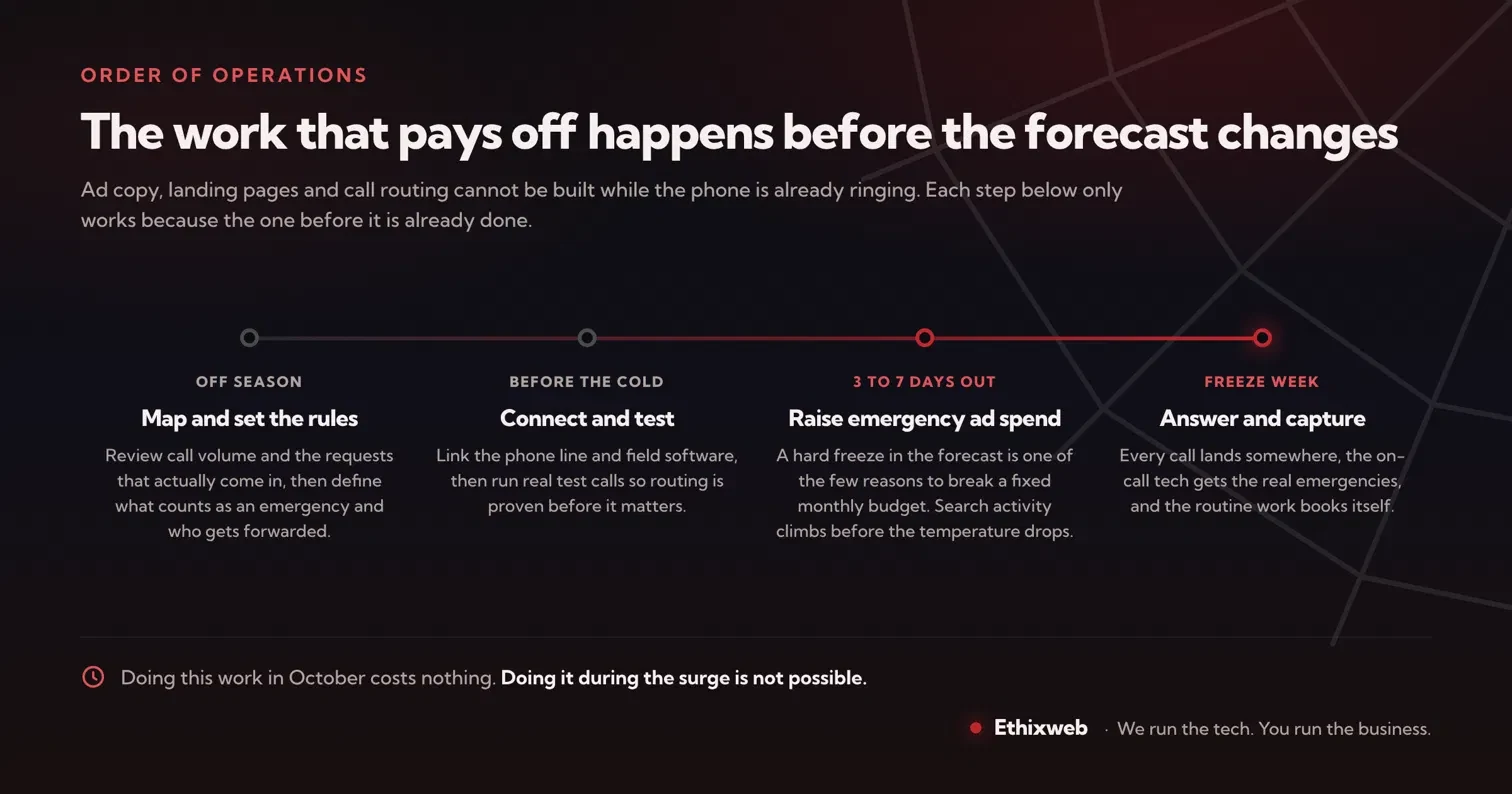
Four step readiness timeline running from off season setup, through connecting and testing the call flow, raising emergency ad spend three to seven days before a freeze, and capturing calls during freeze week
The work that pays off happens before the forecast changes.

Make sure the website can actually take the call

None of the above matters if a homeowner reaches your site on a phone, in a hurry, and cannot find a way to make contact within a couple of taps. A site built for a desktop visitor who has time to browse works against the business the one week a visitor has neither.

This is a short list to check, not a redesign: a tappable phone number or contact option visible on every page without scrolling, a contact form short enough to fill out one-handed, and a page that still loads quickly on a weak signal in a basement or a crawl space.

Questions

Still deciding?

The questions owners ask us most when they are picking field service software, or trying to make the one they already have work with their website.

More from the blog

Local SEO

Google Business Profile Optimization for HVAC & Plumbing

Your Google Business Profile is often the first place a homeowner checks. Seven steps to keep it accurate, complete and useful, from categories and service areas to reviews and lead tracking.

Growth

HVAC Leads Not Converting? 7 Ways to Book More Jobs

When HVAC leads are not converting, more ad spend is not always the answer. Seven steps to find where inquiries get stuck and make it easier for homeowners to book.

Growth

ServiceTitan vs Jobber vs Housecall Pro: which one actually talks to your website

All three run your back office well. None of them were built to plug cleanly into a website you already have. Here's how they really compare, and where the leads quietly disappear.

Local SEO

The Google Map Pack is your real homepage

When a homeowner searches "plumber near me", three businesses show up on a map above everything else. Those three get most of the calls. Here's how a contractor earns one of the spots and keeps it.

SEO

SEO for plumbers and HVAC companies, in plain English

SEO for a home service company is not mysterious. It comes down to a handful of things done properly and kept up. Here's what they are, in plain English, and where to start.

Growth

Local Services Ads vs Google Ads: which one books more jobs?

Both put you at the top of Google, but they work very differently. Here's how Local Services Ads and regular Google Ads compare for HVAC and plumbing companies, and how to decide where your budget goes.

Local SEO

Selling heat pumps in the Pacific Northwest

Heat pumps have become one of the biggest opportunities for HVAC companies around Seattle. The homeowners buying them research for weeks first. Here's how to be the company they call.

Growth

How much should an HVAC or plumbing company spend on marketing?

There is no magic percentage, but there is a sensible way to decide. Here's how home service owners can set a marketing budget, split it across channels, and know whether it's paying off.

AI

An AI receptionist answered while you were on a ladder

A homeowner with no heat does not leave a voicemail. They call the next company. Here's what missed calls really cost a small HVAC or plumbing shop, and how an AI receptionist catches them.

Local SEO

Review harvesting without begging

Most happy customers will leave a review. They just need to be asked at the right moment, in the right way. Here's the routine we set up for contractors, and the mistakes that get reviews removed.

Design

Trust signals that make a $10k job feel safe to book

Homeowners compare two or three contractor websites before they call. The one that feels safest usually wins, even when the work is no better. Here's what creates that feeling, and where it goes on the page.

Growth

Call tracking for contractors: know which marketing books jobs

Most home service leads arrive as phone calls, so most contractors can't say which ad or page produced them. Call tracking fixes that. Here's how it works and how to set it up properly.

Growth

How to get the Google Guaranteed badge

The green Google Guaranteed check sits at the very top of local search results. Here's how a home service company qualifies, what the screening involves, and what decides where you show once you're in.

Local SEO

A seasonal marketing calendar for Pacific Northwest HVAC and plumbing

Demand around Puget Sound follows the weather: heating in the wet months, cooling in short hot spells, plumbing emergencies with every freeze. Here's a month-by-month plan for being ready before the calls come.

Growth

How plumbers win more water heater jobs

A failed water heater is urgent, common and worth a lot. The plumber who shows up first in search, explains the options clearly and answers the phone usually gets the job. Here's how to be that plumber.

Want this done for your business?

Book a free call. We'll review your website, Google profile and ads, and show you where the jobs are leaking.

Book a free call